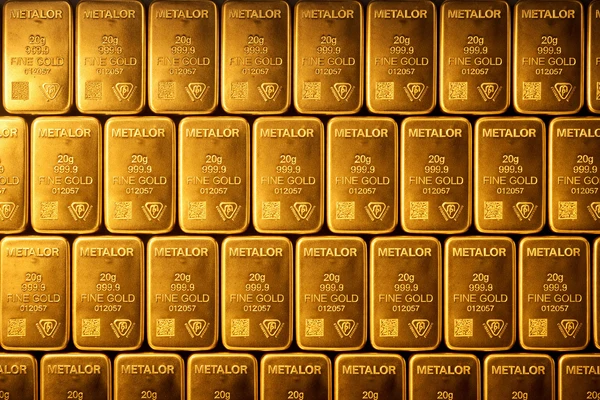
For most of history, money was not an idea.
It was something physical.
Gold and silver needed no explanation. They did not depend on trust in institutions. They did not need policies or external decisions to maintain their value.
They were accepted for what they were.
This direct relationship between money and reality was, however, interrupted.
And the consequences run deeper than they seem at first sight.
The gold standard: stability through limitation
Gold-based monetary systems had one essential characteristic:
limitation.
The quantity of money could not grow arbitrarily. It was tied to a finite resource.
This imposed discipline:
on states
on banks
on the economy as a whole
Expansion was slow. Crises existed, but they could not be “covered” by creating money.
It was not a perfect world.
But it was a world in which money had an anchor.
Breaking the link
The moment the link between money and gold was removed, the nature of money changed.
Money became:
flexible
expandable
dependent on decision
This change allowed accelerated economic growth.
But it also introduced a new element:
dependence on trust.
Modern money: a system based on perception
Today, money is no longer backed by a physical asset.
It is backed by:
trust in institutions
the ability of states to manage their debts
the stability of the financial system
As long as this trust exists, the system works.
The problem is that trust is not constant.
Inflation as a structural mechanism
In the current system, growth of the money supply is not an exception. It is the rule.
Inflation is not just an accident or a deviation.
It is a natural result of the way the system works.
In the long term, this leads to:
erosion of purchasing power
transfers of value
distortions in the perception of prices
For economies, this can be manageable.
For individuals, it becomes directly relevant.
The change in investor behaviour
In a system based on money anchored in gold, saving made sense.
In a system based on fiat money, passive saving becomes problematic.
Investors are pushed towards assets:
real estate
stocks
commodities
Not because all of them are naturally attractive, but because the alternatives are limited.
The return of interest in gold
In this context, gold has not disappeared.
It became less visible in periods of stability.
But it has not lost its role.
Gold remains:
an asset without a counterparty
independent of the monetary system
accepted globally
It is not a universal solution.
But it is one of the few forms of protection that do not depend on promises.
Conclusion
The evolution from gold to paper is not just a technical change.
It is a paradigm shift.
We have moved from a system based on limitation to one based on flexibility.
From a physical anchor to trust.
This has allowed development, but it has also introduced vulnerabilities.
For investors, the implication is simple:
not all forms of money are equal.
And understanding the difference between them is no longer optional.
It is essential.