There is a fundamental confusion in the way most people look at gold.
They compare it with stocks.
With crypto.
With returns.
The typical question is simple:
“How much does it produce?”
That is, in fact, the wrong question.
Gold is not designed to produce.
It is designed to preserve.
And this is exactly where the difference between a buyer and an investor begins.
The illusion of return
Modern markets have taught investors to look for constant return.
Growth.
Multiplication.
Performance.
But this mindset only works in a stable environment.
In reality, return comes bundled with systemic risk.
With dependence on liquidity.
With trust in institutions.
Gold offers no return because it depends on none of these.
It has no management.
It has no balance sheet.
It has no bankruptcy risk.
It does not promise.
It does not explain.
It does not justify.
It exists.
Gold as an asset without a counterparty
Most assets are, in essence, promises.
A share is a promise of performance.
A bond is a promise of payment.
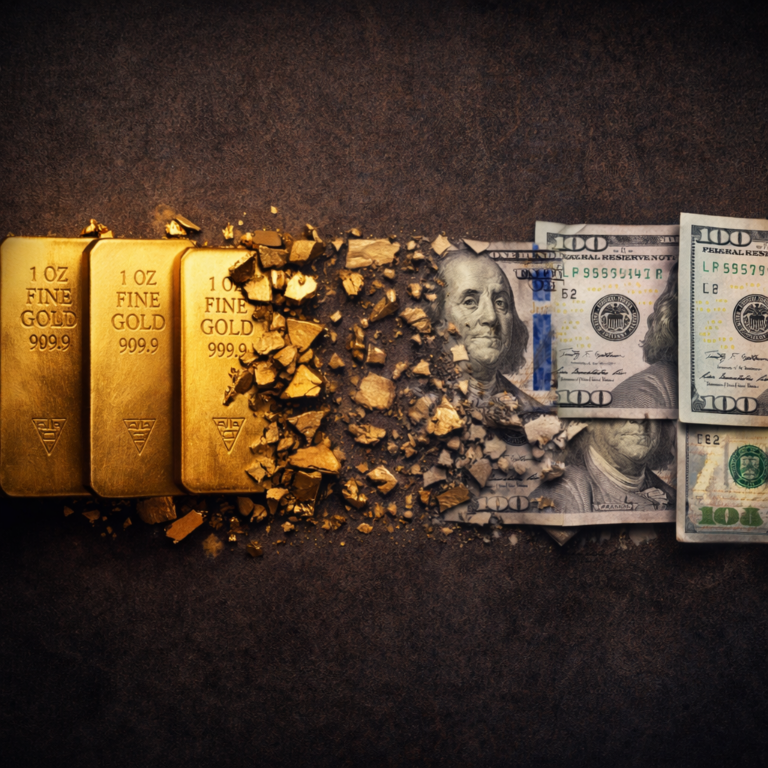
Fiat money is a promise of stability.
Gold is not a promise.
It is an asset without a counterparty.
It does not depend on political decisions.
It does not depend on monetary policies.
It does not depend on trust.
That is why it appears exactly when trust disappears.
The real function of gold
Gold is not there to make you rich in good times.
It is there to keep you from losing in bad times.
It is a subtle but essential difference.
Experienced investors do not build portfolios only for growth.
They build them for survival.
Because, in the end, the loss of capital matters more than the rate of gain.
When gold becomes relevant
Gold becomes relevant in the moments when other systems begin to give way.
Persistent inflation
Aggressive monetary policies
Liquidity crises
Geopolitical tensions
In such contexts, gold is no longer an option.
It becomes a necessity.
The timing problem
Many investors try to “get the moment right”.
That is a mistake.
Gold is not bought perfectly.
It is accumulated with discipline.
Because its value does not come from today’s price, but from the role it plays in the whole.
Conclusion
Gold is not an investment in the classic sense.
It is a form of protection.
It does not generate enthusiasm.
It does not offer the adrenaline of the markets.
It does not create the illusion of getting rich quickly.
But in the moments when other assets begin to fail, gold does not need to impress.
It only needs to work.
And it does.